How much traffic does ChatGPT really send? What referrers and utm_source show
The short version
- How much: in large samples, ChatGPT sends roughly 0.3% of website visits. Ahrefs measured 0.36% for October 2026, SE Ranking 0.32% for May 2026.
- Compared with Google: Google sent about 69 times more visits than ChatGPT in the same Ahrefs data.
- Compared with other assistants: ChatGPT is still the biggest AI source by far, roughly 75 to 87% of AI referral visits depending on the study.
- How to recognise it: the referrer
chatgpt.com(or the olderchat.openai.com), orutm_source=chatgpt.comon the landing page address. - What you miss: visits with neither signal land in Direct, and people who read an answer and later search for you show up as search traffic.
If you want the setup steps rather than the numbers, read How to see visitors from ChatGPT and other AI assistants. This article is about how big the channel is and how to read what you see. To find your own ChatGPT visitors and their landing pages click by click, follow How to see ChatGPT visitors and their landing pages in Countnest.
Definitions
- ChatGPT referral traffic: human visits to your site that come from a link in ChatGPT and carry a ChatGPT signal (referrer or tag).
- Referrer: the address of the page a visitor came from, sent by the browser. For ChatGPT it is usually
https://chatgpt.com/. It never includes the question the person typed. - utm_source=chatgpt.com: a campaign tag OpenAI adds to links in ChatGPT answers so analytics tools can credit the visit. It is part of the link itself.
- Direct or "dark" traffic: visits that arrive with no referrer and no tag. Analytics tools cannot tell where they came from.
- AI crawler: a bot such as OAI-SearchBot, GPTBot or ChatGPT-User that reads pages for OpenAI. A crawl is not a visit. See AI crawlers explained.
How much traffic does ChatGPT send? What the studies show
Each study below measures a different set of websites, so the numbers differ. Read them as ranges, not as one true figure.
| Study (published or updated) | Sample and period | What it found |
|---|---|---|
| Ahrefs, AI vs Search benchmark (updated 19 Nov 2026) | 118,671 sites using Ahrefs Web Analytics, October 2026 | ChatGPT 4.3M visits, 0.36% of traffic. All AI assistants 0.46%. Google 24.74%. |
| SE Ranking (9 Jul 2026) | 101,574 sites with Google Analytics, 250 countries, January 2025 to May 2026 | ChatGPT's share rose from 0.23% in April 2026 to 0.32% in May 2026, the highest month in its data |
| Conductor, AEO/GEO Benchmarks Report | 1,215 US enterprise domains, May to September 2025 | All AI referrals 1.08% of traffic (IT 2.8%, Consumer Staples 1.9%); ChatGPT 87.4% of AI referrals |
| Similarweb (25 May 2026) | Desktop panel, 30 April to 20 May 2026 | After a 7 May 2026 ChatGPT update, ChatGPT referrals rose 157.7% week on week |
Two things stand out. First, the share is small for almost everyone: well under 1% of visits in the large samples. Second, it varies by audience. In Ahrefs' October 2026 regional split, ChatGPT sent 0.49% of visits in Europe and 0.28% in North America, and Conductor found AI referrals on IT sites at 2.8% of traffic, more than twice its 1.08% average.
ChatGPT vs Google: how the shares compare
In the Ahrefs data for October 2026, Google sent 297.8 million visits (24.74%) and ChatGPT 4.3 million (0.36%). By our arithmetic, that is about 69 Google visits for every ChatGPT visit. Within the AI group, ChatGPT's 4.3 million was about 80% of the 5.4 million AI-assistant visits, ahead of Meta AI (757,400), Gemini (183,300), Claude (164,600) and Perplexity (61,300).
SE Ranking sees the same pattern from a different sample. ChatGPT sent 79.74% of AI referral traffic in 2025 and 75.96% in January to May 2026. It is still growing, but other assistants are growing faster.
So ChatGPT is not a replacement for search traffic today. It is a small, fast-moving channel that is worth measuring on its own, because its visitors often arrive with a clear intent and land on a handful of pages.
Why ChatGPT traffic jumped in May 2026
On 7 May 2026, ChatGPT began showing brand names as clickable links inside its answers, according to Similarweb. Its desktop panel showed total ChatGPT referrals up 157.7% week on week and homepage referrals up 354.7%. The share of ChatGPT referrals landing on a homepage went from roughly 26 to 32% before the change to around 60% after it.
Ahrefs' month-on-month figures show the same step: visits from ChatGPT rose 59.4% from April to May 2026. SE Ranking measured a 36.7% rise in ChatGPT's share in the same month.
What this means for you: if your ChatGPT visits suddenly land mostly on your homepage, it is probably this change, not something you did. Judge the channel by both your landing pages and your homepage.
What a ChatGPT visit looks like in your data
A click from ChatGPT can carry two signals.
- The tag in the address. OpenAI's publisher FAQ says ChatGPT "automatically includes the UTM parameter utm_source=chatgpt.com in referral URLs". A visitor lands on an address such as
https://example.com/pricing?utm_source=chatgpt.com. Because the tag is part of the link, it still works when the browser sends no referrer. - The referrer. When the browser passes it, the referrer is
chatgpt.com(older links can showchat.openai.com). Analytics tools show this as the source.
In GA4, recognised assistants are filed in the AI Assistant channel, and you can see the source chatgpt.com. The exact sources, and a tested regex for a custom channel, are in AI referral traffic in GA4.
Some caveats:
- The prompt is never sent. You see where the visit came from and where it landed, not what the person asked.
- Copied links keep the tag. If someone copies a ChatGPT link and sends it to a friend, that visit still says
utm_source=chatgpt.com. A small part of "ChatGPT" traffic can really be shared links. - Crawls are not visits. OpenAI's bots read your pages for search and answers. They do not run your analytics script and do not count as visitors.
Why some ChatGPT traffic arrives as Direct
ChatGPT traffic goes missing in three main ways.
- No tag and no referrer. If a link opens without the tag and the browser sends no referrer, the visit is Direct. This happened at scale in October 2026. Search Engine Land reported (20 October 2026) that after the GPT-6 rollout, ChatGPT links lost the
utm_source=chatgpt.comtag and opened without a referrer. Adobe's Cedric Huesler compared about 500 pages: ChatGPT visits fell by about 31,000 a day while Direct visits on the same pages rose by about 26,000 a day. He said OpenAI confirmed a known bug to him, and that tagged clicks were back to about 95 to 100% of normal after a fix began rolling out on 15 October. OpenAI has not published its own statement. Huesler also said the referrer is still missing on most ChatGPT clicks, which makes the tag the signal to rely on. - The visit comes later. Many people read an answer, close ChatGPT and search for your name or type your address. In a Similarweb study of US desktop journeys in finance, travel and beauty (July to December 2025), people who saw a brand recommended in a ChatGPT answer were 2.5 times more likely to visit it within seven days. Only 8.8% of those visits came through an AI channel. 55.9% came through search and 19.9% were direct.
- Apps and in-app browsers. Links opened from some apps can arrive without a referrer. If the tag has been stripped too, the visit is Direct.
The practical rule: count a visit as ChatGPT when it has either the tag or the referrer, and treat the result as the minimum. Do not label Direct spikes as ChatGPT by guessing.
How to read your own ChatGPT numbers
- Compare with the benchmarks. If ChatGPT sends you around 0.3 to 0.5% of visits, you are in line with the large samples above. If yours is much higher, assistants probably cite you often for your topic.
- Look at landing pages, not just totals. The pages ChatGPT sends people to are the pages it trusts for your topic. Keep their first paragraph a clear, accurate answer.
- Watch Direct on the same pages. If ChatGPT visits drop while Direct rises on the same landing pages and dates, the signal was probably lost, not the visitors.
- Add a note for 8 to 15 October 2026. Your ChatGPT line probably dips and Direct rises in that week. Do not compare across it without the note.
- Use 28-day trends. Daily ChatGPT numbers are small and jumpy.
- Compare crawls with clicks. Pages that OpenAI's bots read often but that never get visits may need a clearer opening. Our free AI readiness checker shows whether your robots.txt lets OAI-SearchBot in, which OpenAI recommends if you want to appear in ChatGPT search.
How Countnest shows ChatGPT traffic
Countnest is privacy-friendly web analytics with an AI traffic view built in. Here is what you see for ChatGPT, with no setup beyond the script:
- ChatGPT recognised from both signals. A visit counts as ChatGPT when the tag says
utm_source=chatgpt.com(orchatgptoropenai), or when the referrer ischatgpt.com,chat.openai.comoropenai.com. The tag is checked first, so a visit with no referrer is still credited. - AI traffic tab. Totals for AI visitors and AI share of all traffic, compared with the previous period, plus engines seen and AI revenue if you send purchase events. A chart shows AI share over time and a trend line per assistant. Countnest recognises 17 assistants, including ChatGPT, Perplexity, Gemini, Claude, Copilot, Meta AI and Grok.
- Landing pages per assistant. The AI landing pages table lists each page with the assistant that sent the visits, the visit count and the bounce rate. Click ChatGPT in "AI visitors by engine" to filter the whole dashboard to ChatGPT visits only.
- AI vs Search visit quality. Visits, bounce rate, average visit length and pages per visit for AI, search and everything else, side by side.
- Crawled but never clicked. If your server logs AI crawler fetches, Countnest lists pages that AI bots read but that got no AI visits, and shows crawlers separately. They are never counted as visitors.
- UTM source filter. Filter any report by UTM source, for example
chatgpt.com, to see exactly which visits carried the tag.
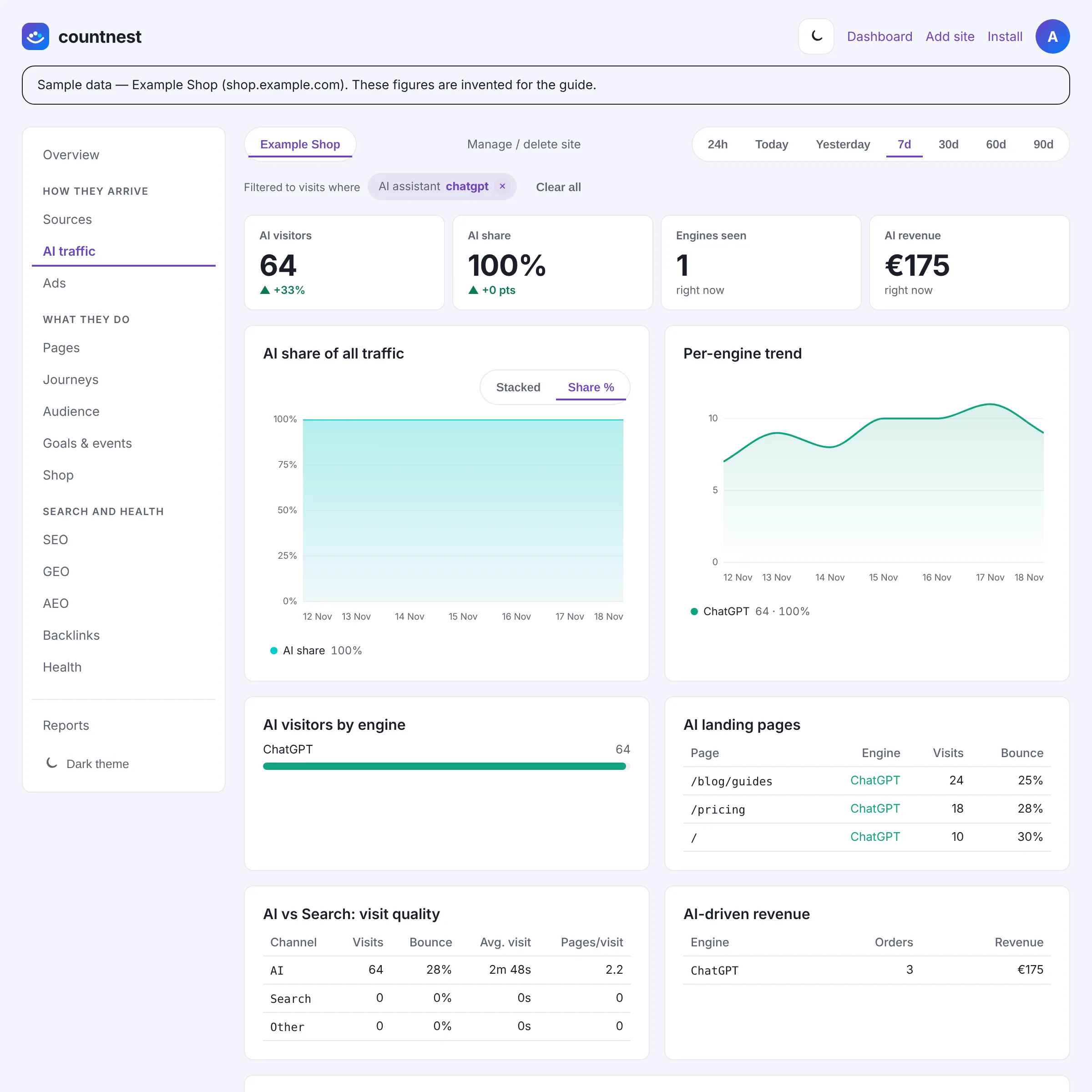
Every click, from the ChatGPT filter to goals per AI engine, is in the step-by-step guide How to see ChatGPT visitors and their landing pages in Countnest.
The screenshot uses invented sample data. Countnest never saves IP addresses and never puts tracking files on visitors' devices. It counts visits and shows totals and trends, not individual people. The product overview is on AI traffic analytics, and plans start at $14 a month on the pricing page.
Honest limits
- Visits with no tag and no referrer are Direct in every tool, Countnest included.
- Google's AI Overviews and AI Mode are not ChatGPT and arrive as Google search traffic. See how to measure Google AI Overviews traffic.
- Benchmarks come from the sites each vendor can measure. Your share depends on your topic, your audience and how often assistants cite you.
- OpenAI changes how ChatGPT links. Check your ChatGPT numbers after big ChatGPT releases.
Related reading on AI traffic
- What is AI traffic?
- GA4's AI Assistant channel: what it shows and what it misses
- How to track Perplexity traffic
- Tag your own links consistently with the free UTM link builder.
Questions and answers
Does ChatGPT send traffic to websites?
Yes, but not much yet for most sites. In Ahrefs' benchmark of 118,671 sites, ChatGPT sent 0.36% of all visits in October 2026, while Google sent 24.74%. ChatGPT is still the largest AI source, with about four in five AI-assistant visits in that data.
What is utm_source=chatgpt.com?
A campaign tag OpenAI adds to links in ChatGPT answers so analytics tools can credit the visit to ChatGPT. It is part of the link, so it works even when the browser sends no referrer. A copied link keeps the tag, so a few of those visits can be shared links.
Why does ChatGPT traffic show up as Direct?
When a visit has no tag and no referrer, no analytics tool can tell where it came from, so it is counted as Direct. In October 2026 ChatGPT links briefly lost the tag and opened without a referrer; a fix began rolling out on 15 October, according to reports. People who read an answer and visit later also arrive as search or Direct.
How does ChatGPT traffic compare with Google?
Google sent about 69 times more visits than ChatGPT in Ahrefs' October 2026 data (297.8 million against 4.3 million). ChatGPT is a small channel next to search, but it grew quickly in 2026, including a jump after a 7 May 2026 change that made brand names clickable.
Can I see what people asked ChatGPT before they visited?
No. ChatGPT does not pass the prompt to your website, and no analytics tool can see it. You see the source and the landing page.
How do I track ChatGPT traffic in Countnest?
Add the one-line script, then open the AI traffic tab. ChatGPT is recognised from utm_source=chatgpt.com or a chatgpt.com referrer, with landing pages per assistant and a filter for ChatGPT only. The 30-day free trial needs no card.
30-day free trial, no card required. Then from $14 a month. Cancel anytime.
Start free for 30 daysSources
- Ahrefs: AI vs Search Traffic Analysis benchmark (118,671 sites, updated 19 November 2026, October 2026 data)
- SE Ranking: Referral Traffic from ChatGPT Hit an All-Time High in May 2026 (9 July 2026)
- Conductor: The 2026 AEO / GEO Benchmarks Report (US, May to September 2025)
- Similarweb: ChatGPT Referral Traffic Near Triples Overnight (25 May 2026)
- Similarweb: Where Is My Customer in ChatGPT Ads & Universal Cart? (15 November 2026)
- OpenAI Help Center: Publishers and developers FAQ (utm_source=chatgpt.com; Web Archive copy of 4 October 2026 read, the live page blocks automated reading)
- OpenAI: Overview of OpenAI crawlers (OAI-SearchBot, GPTBot, ChatGPT-User)
- Search Engine Land: ChatGPT drop in UTM tracking was a bug (20 October 2026)
- Google Analytics Help: Default channel group (incl. AI Assistant)